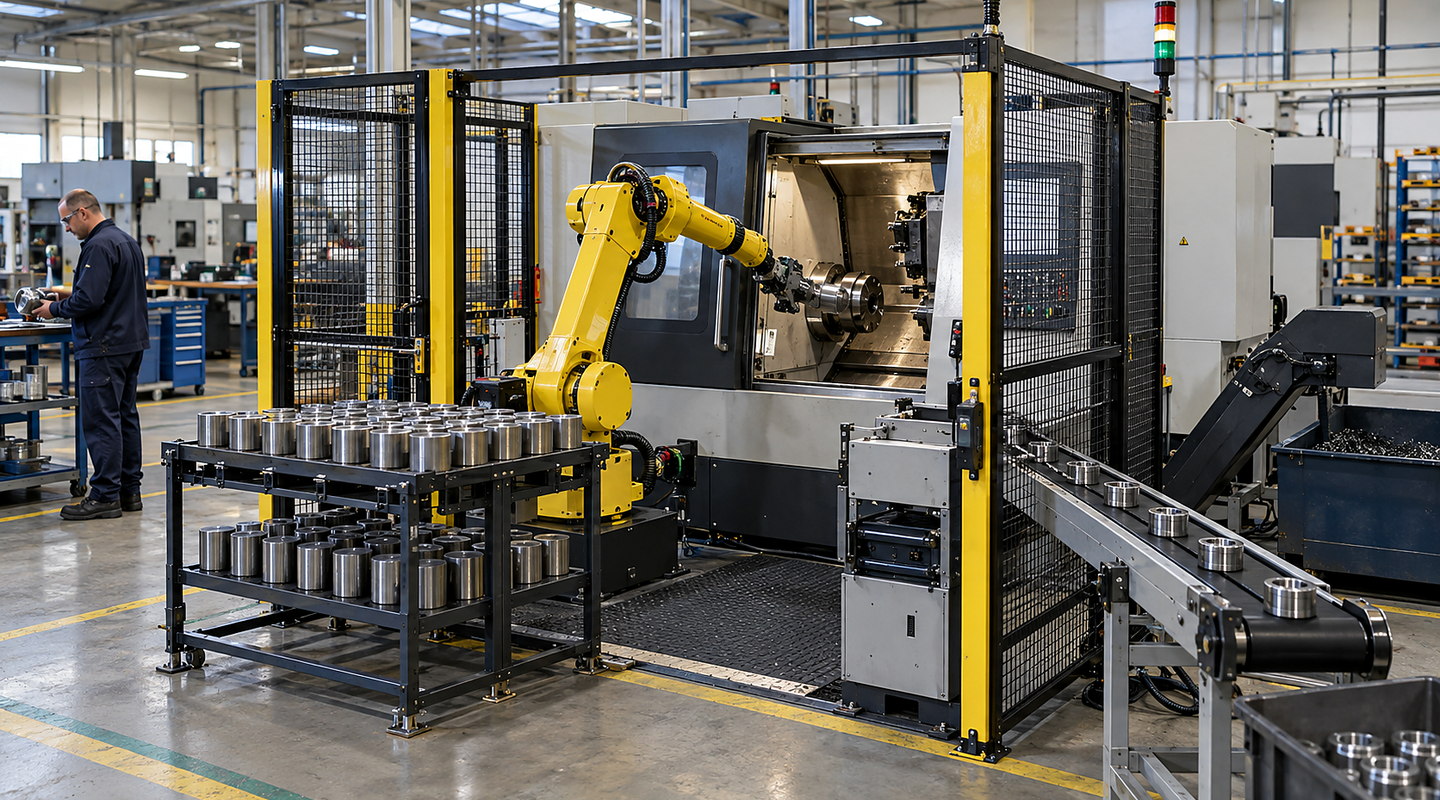
Retrofit or Flexible Cells Involving Robot Simulation and Offline Programming
Plan retrofit or flexible cells involving robot simulation and offline programming around representative parts, tooling and the complete process sequence, line connections, operating limits, acceptance checks and next steps.
In brief
For a retrofit or flexible cell, first establish which layout, robot, tooling, fixtures, programme information and interfaces describe the current installation. Define the proposed change and the variants to be represented; record differences between the available model and the cell on site.
Separate retained equipment and behaviour from the proposed work. Use the interface review to assign missing information, physical checks and the evidence needed before a changed sequence is accepted.
On the production floor
Plan for the conditions your team handles every day — Robot Offline Programming
Plan robot offline programming around your parts, process, cycle time, tooling, recovery and acceptance criteria. Discuss the highest-risk feasibility questions with Oxford Industrial Automation. For retrofit or flexible cells involving robot simulation and offline programming, the deciding details include part, product and process variation for robot simulation & offline programming, required cycle and production pattern and run-off criteria and production evidence.
Details worth resolving early for retrofit or flexible cells involving robot simulation and offline programming
Question 1
Part, Product and Process Variation for Robot Simulation & Offline Programming
Identify the existing and proposed part variants and the revisions of the layout, fixtures and tooling used to represent them. Record which differences can be reviewed in the model and which require a survey, measurement or physical trial.
Question 2
Arrival Pattern and Presentation
For retrofit or flexible cells involving robot simulation and offline programming, describe the current position, required outcome, acceptable limits and known exceptions for arrival pattern and presentation. That lets us compare options against your real production rather than one nominal value.
Question 3
Required Cycle and Production Pattern
For retrofit or flexible cells involving robot simulation and offline programming, describe the current position, required outcome, acceptable limits and known exceptions for required cycle and production pattern. That lets us compare options against your real production rather than one nominal value.
Question 4
Tooling, Sensing and Process Interfaces
List the interfaces that will be retained, altered or added, together with the available drawings and behaviour descriptions. Identify assumptions about other equipment and assign who will confirm them before the changed sequence is put into routine use.
Question 5
Operator Access, Recovery and Changeover
Plan the changeover around the existing operating arrangement, authorised programme and setting backups, and a documented response if the changed sequence does not meet the agreed checks. Record who controls revisions and who confirms the resulting physical arrangement.
Question 6
Run-Off Criteria and Production Evidence
For retrofit or flexible cells involving robot simulation and offline programming, describe the current position, required outcome, acceptable limits and known exceptions for run-off criteria and production evidence. That lets us compare options against your real production rather than one nominal value.
Your operating cycle
Plan for more than automatic running
Include replenishment, normal production, planned change, short stops, fault recovery, cleaning and maintenance for retrofit or flexible cells involving robot simulation and offline programming. A fast automatic step can still leave your team with a slow or awkward overall process.
Normal production and variant changes
Replenishment and material presentation
Operator access and safe interventions
Cleaning, maintenance and recovery
Prove the result
Test retrofit or flexible cells involving robot simulation and offline programming against representative parts, tooling and difficult cycle conditions
Normal production
Run the agreed product or part mix for retrofit or flexible cells involving robot simulation and offline programming at your intended operating pattern.
Difficult conditions
Include credible extremes for part, product and process variation for robot simulation & offline programming and arrival pattern and presentation.
Fault and recovery
Review the effect of an interruption or an unexpected response in the proposed sequence. Record which recovery decisions can be considered in the model and which require the assessed procedure and checks on the physical cell; do not treat a simulated restart as permission to restart production.
Important limits
Be clear about what the trial has shown
Cycle time depends on the complete process rather than robot speed alone.
Part presentation, tolerances and recovery cases must be included in feasibility work.
Collaborative operation or automatic handling cannot be assumed safe without an application assessment.